|
The World Federation is an NGO in Special Consultative Status with the Economic and Social Council (ECOSOC) of the United Nations
Vision Statement
The World Federation
exists to achieve the
pleasure of Allah SWT by
developing spiritual and
vibrant communities
serving humanity
Mission Statement
The World Federation
enables its member institutions
to promote the
values and practices of the
Islamic Shia Ithna Asheri
Faith for the spiritual and
material well being of
humanity at large
|
From Strategic Plan to IIPS Damascus - From Vision to Action to Reality
|
|
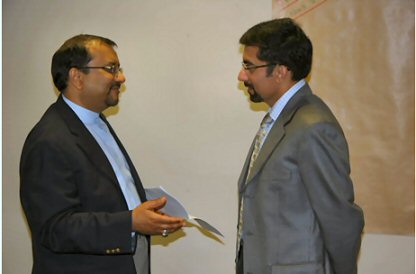
| Dr Hasnain Walji (left) with the MTP adjunct professor, Dr Hamid Mavani |
To survive as a vibrant living entity, the community has no choice but to keep abreast of the changes around it, understand the impact of the modern era and adapt to the changing world. To that end, in 2002 The World Federation initiated the process of deliberating upon the framework within which we may begin making gradual changes so that the needs of the community were adequately catered for in the future. This was the motivation for us to engage the community in a Strategic Planning exercise and solicit input and involvement of the grass root members of the community.
This was a very exciting time for The World Federation – with a well-established structure and strong community backing, it was well placed to build a collective vision to look to the future for the Shia Ithna-Asheri community worldwide. Amongst the issues tackled in the Strategic Plan was the effectiveness of dhakeerin and muballigheen. The surveys suggested that while the demand for Islamic Education was strong, the perceived effectiveness of current efforts to impart Islamic Education was seen as relatively ineffective by the community. At the same time, only Africa and the Middle East seemed to feel that their dhakireen were relatively effective at communicating with them, while the rest of the world largely felt that their dhakireen were not relating to all parts of the community. Scores revealed that generally dhakireen were perceived as ineffective and that this sentiment was noticeably more pronounced in the youth (ages 19-24). Furthermore, there was sufficient empirical evidence to suggest that the community wanted The World Federation to work with ulama and dhakireen to make education of the community more effective.
Following consultations with ulama and dhakeerin at a brainstorming retreat, The World Federation embarked on the creation of the Muballigheen Training Program and subsequently the establishment of the Islamic Institute of Postgraduate Studies (IIPS) in Damascus.
It is pleasing to note that as the 'doors of knowledge' at the IIPS open this week, in the proximity of the shrine of Sayyida Zaynab (AS), one can look back and feel blessed to observe this model journey form vision (2003) to action (2007). InshAllah, the reality will be when the first graduates of the IIPS will grace our mimbers and mihrabs effectively engaging the future generations, in the years to come. Suffice it to state that the integrated program, combining the traditional hawza curriculum and the methodologies of the western academia will effectively equip them to be relevant to their audiences.
The unique integrated curriculum takes into consideration that as a result of globalization of culture, one of the greatest challenges facing us today is that we are pervaded by ideas inimical to Islam and promulgated within the school, universities, work place, and the media whose pervasiveness cannot easily be halted. This concern becomes all the more acute because of the inaccurate portrayal of the teachings of Islam, which is no longer limited to one part of the world. We have become all the more vulnerable and exposed to the danger as it has begun to creep in and take root, from within our own community, suggesting that our young are not immune to this mis-definition. To counter this, we must see to it that our young men and women are introduced to abundance of unapologetic scholarly works where many answers are already given to problems of today in the most intellectually satisfying way. This is particularly for university students, for they live within an ethos that subjects them to a plethora of ideologies and which demand of them a more rational explanation in matters of belief. This is a major challenge facing us needs our utmost consideration.
It is for this reason, the MTP/IIPS, with its integrated curriculum is such an important project, which deserves all our support. The project is as exciting as it is challenging. Undoubtedly it will question the status quo, and has already moved some of us from our comfort zone.
But then we are a vibrant community and expect no less from ourselves, as Allama Iqbal says:
Nishan vahee hai zamaney men zinda Qaumon ka
Keh subah-o-sham badaltee hai inki taqdeeren.
In every age this alone marks a vibrant race
That every morn and eve its fortunes do change.
Dr Hasnain Walji
Former President
The World Federation of KSIMC
7 September 2007
|
What's New :: Islamic Education
|