Updated 15 May 2013
We have been informed by Br Abdul Razak Gokal that an article on his late father Marhum Abdulhussein Jetha Gokal published in good faith in 2008 had several inaccuracies and we hereby unreservedly apologise to him and his family for the inaccurate report and for any offence, anguish and embarrassment that the family had to endure. We hereby, put the matter right by publishing a revised article as edited by his family.
Among the many killed during the tyrannical rule of Saddam Hussain in Iraq was Al-Haj Abdul Hussain Jetha Gokal, who was executed by the Ba’ath party in Basra on 27th January 1969, aged 58. Originally from Karachi, the Jetha Gokal family migrated to Iraq in the late 1930s.
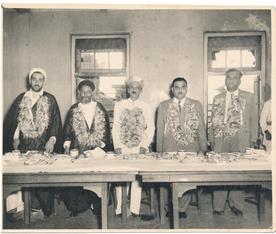
Abdul Hussain Gokal with Faiz-e-Panjatan, Bombay, (second from the right)
Abdul Hussainbhai had three sons, namely the late Mohamed Ameen, late Mohamed Ali and Abdul Razak (who resides in London), and four daughters.
Abdul Hussainbhai was a successful businessman. Together with his family, he established a prosperous export dates business. He was also famous for his extensive philanthropic and community work, which included building hospitals and masjids, including the renowned Masjid-al-Joumhouria in Basra, adjacent to which a street was named in his honour by the local community. Moreover, Abdul Hussainbhai was an ardent supporter of the hawza, and was very close to Syed Mohsin al-Hakim and other notable maraja.
He regularly received zawars from across the world, including East Africa, India and Pakistan, providing them with extensive hospitality. As a representative of Faiz-e-Panjatan, Bombay, he also established and maintained several musafirkhanas in Karbala, Najaf and Kadhmain.
Despite his extensive charitable work, he was arrested in November 1968 by the Iraqi Ba’ath Party on trumped-up charges of espionage. Abdul Hussainbhai was tortured and falsely implicated. It was further reported at the time that the pleas for clemency were ignored and the legal process was flawed.
Abdul Hussainbhai is buried in Wadi as-Salam, Najaf. His grave, located minutes from the haram of Imam Ali (a.s.), is marked by a tombstone, and his legacy as a compassionate and generous man lives on.
Imam Ali (a.s.): “Live amongst people in such a manner that if you die they weep over you and if you are alive they crave for your company.”