Organised by the Education Committee of The Council of European Jamaats (CoEJ) in conjunction with Islamic Education Board of the World Federation and Madrasah Imam Ali (A.S) Qum.
Report by Zameer NazarAli – Group Representative
The spiritual and cultural camp of Iran 2004 opened the eyes of many and touched the hearts of all.
It was a trip that added to the obvious and truly beautiful ziyarat, a trip in which all participants gained an insight into what living Islamically, actually and practically means. The beauty of which can only be compared to the rays of the sun, which nurture all that come into contact with them. Every moment in Iran was as though we were in the rays of the sun, constantly and steadily growing in soul, spirit and mind.
The objective which was attempted to be achieved by the organisers I feel was to open our eyes to how one can strive spiritually despite all that is around us. To free our minds of negative influences and instead to combat this with positive and powerful propagation through our actions, thoughts and words.
The main feature of the trip was the Islamic studies short-course, which was divided in to four modules - Ahkam, Akhlaq, Aqa’id and Characteristics of Shiaism.
The main focus from the short course was to build on the fundamentals, develop a foundation that was strong so that future complex subjects could be studied and understood easily. This was focused on building our foundations of Islamic belief, giving us an in depth understanding of the fundamentals of our pure faith.
The series of lectures on Aqa’id and Akhlaq aimed to strengthen the basic beliefs of the students, and guided us as to how we may implement these precepts in our lives. These lessons were delivered to us by Sheikh Muhammad Khalfan and Syed Salman Naqvi.
The Aqa’id course began with the search for a correct belief, went on to discuss the role of human intellect within our religious reasoning and slowly built up on the necessity and fundamental nature of our ‘Roots of Religion (Usul-e-Din). What this did was to allow us to understand why these things were important rather than simply stating that they were.
Akhlaq gave us further insight as to why Islam incorporates this aspect of etiquette. Prophet Muhammad (S.A.W) was sent to perfect the human morality and character. The overall goal is to emulate the characteristics of Allah. In these lessons we discussed the types of knowledge, conceptual and presential, which is gaining knowledge by presence. To site an example given to differ one from the other looking at a pen and knowing that it exists is conceptual knowledge, however knowing that an image of the pen exists in your own mind is presential knowledge.
The topic of Akhlaq branched out into various degrees and finished with lessons on ‘Enabling Receptivity’. The first step of gaining nearness to Allah is wakefulness, in order to achieve this state; one must be receptive to it. Ten steps were covered including perpetual dhikr of Allah, love of the Ahlul Bayt and Tawba. This was the spiritual side of the course. It opened in us that desire to seek the pleasure of Allah.
The second section of our studies illustrated how to implement this knowledge practically in to our lives. Ahkam lessons were taught to us by Dr Murtaza Alidina. He guided us through the process of how a Mujtahid makes a decision or ruling, showing us the types of factors that would be considered and the interpretation of Ayats of Qur’an and Ahadith. These lessons were reinforced when we visited various Ulema. The visits gave us a true understanding as to how tasking their work truly is.
The final lecture given by Sheikh Ali Shomali, Characteristics of Shiaism, was a most enlightening and fascinating subject. Sheikh Shomali explained how to adopt Characteristics such as rational thinking, correct analysis of research and how to walk on the path of finding the true purpose of existence, being the striving of man towards the Perfect and All-Encompassing Lord Allah, the Exalted, the High.
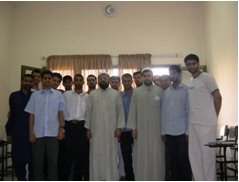
We were also blessed to have time with Syed Razavi, who was our Qur’an teacher. He is a truly special person, and treated us to fantastic recitation of the Holy verses.
 |
A beautiful quote was given to us, which encapsulates the importance the type of insight we were given throughout the Course:
“The truth is like a beautiful clean house. But our lower desires and lust are like dusts that make the house untidy. Don’t you see that whenever there is dust you cannot see even if you aren’t blind? When your heart is open to these lower desires, you will not be able to hear the true secrets of the world.”
Sheikh Sa’adi (Persian Poem) |
If the main purpose of the course was to gain and strengthen the knowledge of our faith, the purpose of the trip as a whole was to visit the Holy personalities situated in Iran, the infallible Hujjat of Allah, Imam Ali Ar-Ridha, and the pure sister of Imam, Bibi Ma’suma-e-Qum. Within this is included our trips to the spiritual venue of Jamkaran, and the wonderful sight of the Imam Khomeini Mosque in Tehran.
The sheer atmosphere in both Harams, of Qum and Mashad, moved us in a way that cannot be described. We felt at home, amongst friends. We could be Shi’a without repercussion, we witnessed small bands of people commemorating the martyrs of Kerbala, others giving constant salaams to the Ahlul Bayt. Sajdagah were easily available and the traditional accusations of ‘bid’a’ were only a distant bad memory. These may seem like obvious and minimal things, but having not experienced being in a Shi’a country before, it was these small factors which really made a difference.
Jamkaran was an amazing experience as well. On our first visit to the prestigious Mosque, we were taken a back by the sheer number of people, who came to pay tribute and commemorate the death of Bibi Fatemah (AS), the pure daughter if the Messenger. We estimated around 500,000 people at least, which is easily one of the biggest congregational prayers we had been involved in. And the feeling of knowing that perhaps our beloved Imam of the time, Al Hujjat ibn al Hassan Muhammad Al Mahdi (AS), could be in attendance, was a feeling beyond any description.
The Cultural aspect of the trip brought to the campers a wide perspective of the lifestyle in Iran. We witnessed the deep beauty filled throughout this amazing country, seeing the natural wonders possessed within its borders. From the scenic venue of Isfehan, known as Nisf Jahaan, to the spectacular caves of Hamadan, which included spectres of all shapes and sizes, colours and textures, we were spoilt with splendour.
This beauty was not only appreciated materially, or simply at face value. In every amazing sight, every beautiful simplicity, there was a sign of the Perfected Creator, one which we could ponder and remain in awe of His magnificence. In the breath taking scenery of Northern Iran, by the Caspian Sea, our supervisors demonstrated analysis of our lives, which touched the core of our souls. A comparison made between our lives, and the waves of the sea, striving towards the shores of perfection, against the bounds of time, before crashing against the rocks of death, and returning to the source of its creation. SubhanaAllah, His signs are here for those who contemplate.
In Tehran there was much contemplation, as we began to attain an understanding of the roots of the Revolution, and the component parts involved. We could compare the majestic palace of the Shah, against the humble surroundings of the revered Imam Khomeini. It was a great experience, to see how these two leaders contrasted in philosophy, spirituality and guidance.
This type of culture was reflected in many places we visited. The atmosphere in Qum for example, and in the Haram of Imam Ridha (AS) in Mashad, had a unique and pure nature. Qum is certainly the city of peace, and everybody seems satisfied with minimal material possession, especially in the institution of the Madressah Imam Khomeini. Sleeping in sleeping bags on the floor, not having easy access to the Internet or TV, hand washing clothes. These are all things that perhaps from a Western perception could be classed as very simplistic, even a denying of luxury. However in Iran, these things were not issues, there was no problem at all as our desire for luxury became curtailed, and the tranquillity of the heart and soul increased.
A truly momentous moment which encapsulated the spirit of brotherhood was when one of the campers had some bad news of a death in the family. After most of the campers had gone to the rooms to prepare for bed, we called a small majlis. Every single person from the two groups attended, and one by one gave their condolences. This memory will stay in the heart forever, as it showed true feelings of love, compassion and etiquette.
We also had the opportunity of meeting some wonderful personalities. We were truly in awe of the superb recitation of Allama Ja’fer Tabbar. We enjoyed being the presence of representatives from the government, Ayatullah Tabata’i, Ayatullah Adawi and Ayatullah Akhtari. It was an honour to meet the inspiring Marja', Ayatullah Fazel Lankarani, who despite ill health gave us his time and shared with us valuable guidance. The final meeting was with Marja' Ayatullah Nassir Makarim Shirazi, with whom we had the opportunity of having a question and answer session, and joined him for Maghrib and Eisha salaat. It was truly moving to witness their humbleness and dignity. They each expressed what an honour it was to be in our presence. This was such a powerful statement, showing the purity of these dedicated servants of Allah (SWT).
I could not possibly write a report on this magnificent trip without giving a huge thanks to all the supervisors and organisers. It was one of the features of the whole trip, the way each member of the supervising team went out of their way to assist us and to make each leg of the journey as comfortable as possible. Syed Salman provided insight and knowledge throughout, Sheikhs Mohamed Ali and Abbas Ismail were excellent in organisation and work ethics, providing us with what popularly become known as ‘gems of wisdom’. Their experience of coming from the west enabled us to communicate with them both easily, something we thoroughly enjoyed. Sheikhs Azim, Haider and Nadir passed on to us their experiences of living and studying in Qum, as well as tirelessly attending to our every need. Agha Hussein Pur provided us every type of service we could think of, from video duty, picture taking, recitation of beautiful poetry and an array of artistic calligraphy, he soon become renowned as the master of all trades he practiced. Of course Mahmood Dhala and Shabbar Dhalla have worked so hard to help us reach this pure and spiritual destination. Mahmood Dhala, the Chairman of the Education Committee of CoEJ was also in attendance in Mashad, and delighted us with his warmth and sincerity. I also would extend thanks to our knowledge filled lecturers mentioned earlier. We pray they are all rewarded amply and continue to have the opportunity of continuing the sincere efforts.
This was a character building trip, as well as spiritually enlightening. I feel as a group we went expecting much, but returned understanding that our expectations were far exceeded. That truly living the life of Islam requires a detachment form material things, and equally is the implementation of practical, achievable goals to reach the objective at hand. This is something that one truly cannot expect, only experience.
Reflections from Mashad, Iran
Report by Wahid Amin
I seek the protection of Allah (s.w.t) from the cursed Shaytaan for whom has been ordained a period of eternal disgrace and punishment. He has been expelled from the kingdom of Allah (s.w.t) for two reasons: his arrogance and rebellion against Allah (s.w.t). I begin in the name of Allah (s.w.t), who is beneficent toward all of his creation, and showers his special mercy upon the righteous servants.
The journey to Iran began in the presence of the infallible Lady of Qum; it can only be fitting then that we spend our last few days and nights in the presence of, and bidding farewell to, an infallible before we return to our normal, spiritually deprived and over indulged lives. The hope is that at least some part of this experience can be taken away with us, to change and reform our lives and prepare ourselves for the return of the last of the infallibles, Imam al-Asr al-Hujjah al-Muntadhar al-Imam al–Mahdi (May our lives be sacrificed for him).
As I sit and begin to reflect upon the previous three weeks, I realise that our time in Iran has impressed upon me the most significant and meaningful messages that will remain with me for the rest of my life. Every part of this nation - its people, its historical sites, its respected and honourable dignitaries - preserve in them at least some small portion of this country’s legacy and history. The Iranian Revolution of 1979 and the nation’s commitment towards the Imam of our time are clearly visible in the manner in which its affairs are conducted and in the way the people live their lives.
Upon arriving in Mashad we were pleasantly surprised to find that our apartments contained western toilets and beds to sleep in. This may seem like a strange comment to make, but part of the spiritual fashioning our organisers had in mind was implemented through lateral thigh presses and spine crunching exercises.
Our first visit was to the museum and library within the shrine of the Imam. It contains relics of the 1979 revolution, as well as the many gifts received from and given by Ayatollah Khamenei and other celebrity figures from all over the world. There are also very old and very interesting scriptures of the holy Qur’an, some of which are even attributed to the first holy Imam. The library located on the site, is the largest library in Iran.
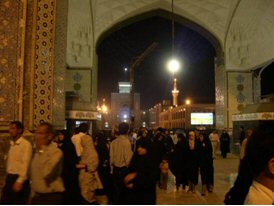 |
As I approached the holy shrine to offer my first official salutation to the Imam, it quickly became apparent to me how big the complex has become since my last visit to Mashad nearly twelve years ago. Another striking feature this time around is the huge masses of people that visit the holy shrine. The vastness of the complex can be quite confusing and unlike the holy shrine of Masooma Qum, the shrine of Imam Reza (as) is a noisy, hectic and a frantic affair. |
The invitation of Imam Reza (as) to eat in the building adjacent to the shrine is a famous tradition that has been taking place for many years. I was happy to be among the honorary guests of the Imam and I found it to be a spiritually comforting event. One cannot help feel guilty though knowing that there are crowds of hungry and homeless people outside – waiting for you to leave the canteen having filled yourself with the food on offer and in the hope that you may have taken some with you to offer the people outside.
Our three-day stay in Mashad happened to include laylatul-jumu’ah and we were fortunate to have been able to sit in on the recitation of Dua al-Kumayl. For me this will be a distinct memory of our time in Mashad, and I found it to be a peaceful conclusion to the four weeks we had spent in Iran.
Mashad is also host to many street bazaars and shopping markets. The Razavi market is probably the largest and most popular bazaar in Mashad that is visited by pilgrims and tourists from all over the world. Many members of the group had delayed their shopping until Mashad and the Razavi market was a popular location for bargain hunters to pay a visit.
All-in-all many of us enjoyed our time in Mashad and only wished that we had more time to spend in offering prayers and residing within the holy shrine of the Imam. I would recommend the organisers of future trips like this to make every effort to spend a greater period of time in Mashad.