Updated 13 January 2010
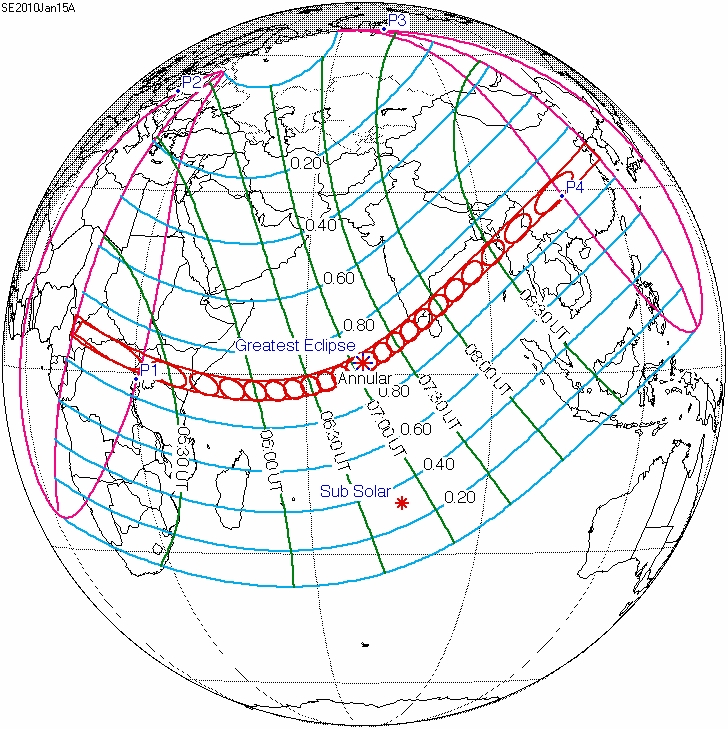 On Friday, 15 January 2010, an annular eclipse of the Sun is visible from within a 300-km-wide track that traverses half of Earth.
The path of the Moon's antumbral shadow begins in Africa and passes through Chad, Central African Republic, Democratic Republic of the Congo, Uganda, Kenya, and Somalia.
After leaving Africa, the path crosses the Indian Ocean where the maximum duration of annularity reaches 11 min 08 s. The central path then continues into Asia through Bangladesh, India, Burma (Myanmar), and China.
A partial eclipse is seen within the much broader path of the Moon's penumbral shadow, which includes eastern Europe, most of Africa, Asia, and Indonesia.
Do not attempt to observe the partial or annular phases of the eclipse with the naked eye. Failure to use appropriate filtration may result in permanent eye damage or blindness!
There is no pain when the retina is being burned, and the resulting visual symptoms do not occur until at least several hours after the injury has occurred - by which time it is far too late.
Click here to view an interactive map of the path of the eclipse
Click here to view an animated simulation of the eclipse
NAMAZ -E-AYAT
The rules and method of Namaz-e-Ayat is given in Aytullah Seestani’s Risala (Masails number 1500 to 1524). The Namaz is Wajib on all of those individuals whose regions will experience the eclipse. It should be started as soon as the eclipse starts and should be completed preferably before the maximum eclipse. It can however be prayed till the end of the eclipse with Niyyat of ‘Ada’.
Click here to access some important clarification related to the performance of Namaz-e-Ayat.