As the first year of the Muballigheen Training Programme comes close to an end, the IIPS management team invited external evaluators to assess the success of the objectives defined for the first year. These evaluators shall lecture some of the modules taught to the students in their second year.
Chief Guest
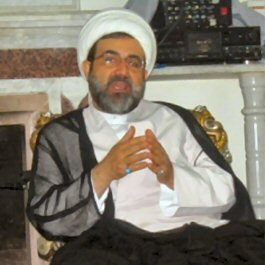 The Guest of Honour during the evaluation programme was Sheikh Haleem Al Bahbahani, the representative of Ayatollah Seestani in Syria. One of the students had the following to say on Sheikh Haleem’s visit to IIPS: “We were fortunate enough to have the Representative of Ayatullah Seestani, Sheikh Haleem Bahbahani with us on Saturday 03 May 2008 at the IIPS. Sheikh Haleem spoke about the importance of us, as pioneers of this programme to succeed, stating that our success would define the success of the Institute in the coming years. He was excited to see us coming to the end of our first year, where we have developed the fundamentals necessary for the upcoming years, as we begin our journey closer to Allah (SWT). Sheikh Haleem gave us two very important pieces of advice;
1) Practice what you preach, because people will now look at us as role models.
2) Understand that the responsibility that we have undertaken makes us more accountable to Allah (SWT).
Sheikh Haleem also provided us with an opportunity to ask questions. At the end of the meeting, he presented each of us with a personal gift from Ayatullah Seestani. We are very grateful for his visit and it is comforting to know that Ayatullah Seestani is supporting us through our endeavours”.
Sheikh Haleem commented, “Generally I am very happy with the way the students have progressed this year. As they will be tackling new and important subjects in Arabic next year, I am confident that they shall do well. It is an individual responsibility for each student to implement what they have and will learn, in order to portray to the community as Muballigheen”.
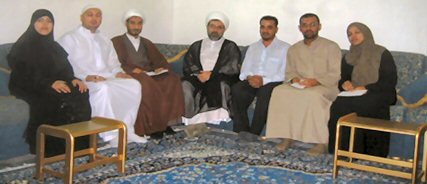
Sheikh Haleem Al Bahbahani with IIPS Students and Staff
First Year Curriculum
The main purpose of the first year is to equip students with the necessary knowledge and skills in Arabic, preparing them for the second, third and fourth years, during which the whole curriculum is undertaken in Arabic. The following areas are covered in the first year:-
- Introductory level: The Arabic alphabet (letter recognition and writing), pronunciation, sound diacritics, passive reading and writing and the use of basic vocabulary and common expressions for daily communication.
- Level I (Elementary): Fundamentals of standard Arabic through vocabulary building, comprehension and using short communicative dialogues.
- Level II (Intermediate): Reading, communicating and writing in Arabic, with a continued emphasis on the acquisition of vocabulary, necessary derivations, structures and grammatical patterns necessary for comprehension of traditional Arabic at the intermediate level.
- Level III (Advanced): Developing advanced language skills in acquiring and using Arabic patterns, expressions and discourses of connected speech.
- Arabic Comprehension: Classes specifically dedicated to Arabic Comprehension, through active listening.
- Arabic Dictation: Concentrating on the fundamental rules of written Arabic and understanding the logic behind this, thereafter implementing these rules through supervised dictation.
- Hadith Shareef: Understanding authentic Ahadith, deeply analysing the meanings of each word used, with reference to Arabic Grammar. Following this, general sentences would be created, enabling the students to fully understand the relevant Ahadith and its implications.
- Quran (Recitation and Tajweed): Teaching the foundations and rules of the Holy Quran, its composition, history and pronunciation. In addition, students learnt accurate recitation and studied specific verses.
- Fiqh: Familiarisation of important terminology frequently used throughout all Islamic jurisprudence.
- Aqaid: Introducing the fundamental topics of Aqaid, to create awareness on the roots of the faith.
- Tutorial: A platform to clarify and discuss all subject matters undertaken by students.
- Practical Exercises in Islamic Rituals: Students have also been given practical lessons on performing Islamic Rituals in the correct manner.
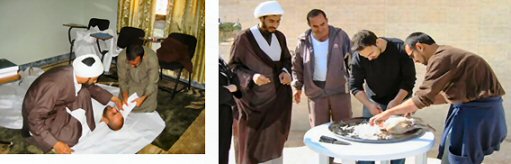
Performing funeral rite Halal slaughtering
Feedback following Evaluations
The external evaluators gave short lectures in Arabic and tested the students’ levels of comprehension. The evaluators were asked to grade the students’ ability of speaking and understanding Arabic, through tactful prompts and short lectures. The highest grade attained by one of the students was 95%, and the class average was 76.2%. Following completion of the evaluations, students and evaluators were asked to provide feedback.
Comments from Samara Iqbal (Student) following Dr Riaz Akhras’ (Evaluator) lecture on ‘Tafsir’:-
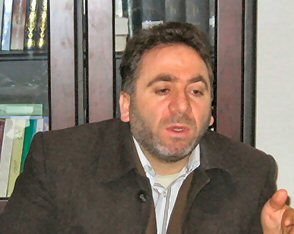 “The short lesson with Dr Riaz proved very useful and provided us with a flavour on the subject that we will be studying next year. Tafsir of the Holy Qur’an is undoubtedly one of the most interesting subjects within the Islamic field. It deals with understanding the perplexities and ambiguities we face when trying to comprehend and rationalise the Holy words of our Supreme Lord, Allah (SWT). Dr Riaz was enthusiastic, fast paced and kept us glued to our seats. He threw questions such as ‘why is Tafsir of the Quran so important’, ‘Why are parts of the Quran ambiguous’, in order to assess our understanding of the term ‘Tafsir’. And finally, after pointing out that tafsir of the Quran has been done over a thousand times, he posed an interesting question, asking about how we would discern an authentic view from a false one. He thereafter added that if Tafsir is ambiguous, who is to say that any Tafsir is correct. These intuitive questions were important in the philosophical approach that is required in comprehending the eloquent and unique meanings (coherent and inherent) within the Qur’an. Dr Riaz’s approach was fascinating and enjoyable, making us all eagerly anticipate the in depth analysis of the subject next year. Dr Riaz also ended the tutorial with a joke, which enlightened us all after such a roller coaster session”.
Feedback from Dr Riaz:-
“Generally the students are good in Arabic and there is a dramatic difference from the last time I came to the Institute. It is my opinion that all the students are ready to take lessons in Arabic next year”.
Comments from Hassanain Aleem Mir (Student) following Sheikh Kassim Akhundy’s (Evaluator) lecture on ‘Logic’:-
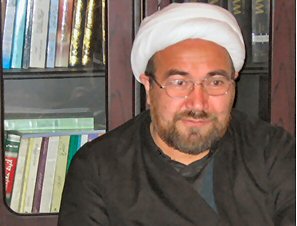 “This was one of the most interesting and eagerly anticipated subjects as it deals with the topic that both the eastern and western worlds hold with the greatest of regards. The use of Logic is one, which all rational thinking bodies pertain to. It is a subject matter, which is referred to and utilised in order to compare, substantiate and prove many a theory and ideology. The tutorial conducted by Sheikh Kassim on Mantiq was introduced in a very interesting, thought provoking and interactive manner. The novelty in Sheikh Akhundy’s approach was that he was first and foremost interested in our understanding of the subject. This, coupled with his respect for everyone’s views without being dismissive of any point of view was thoroughly refreshing. The tutorial was based upon a couple of questions, which on first appearance seemed very straightforward. They were ‘what is knowledge’, and ‘where is it stored/located’. From the answers, discussions and conclusions that ensued, it was obviously apparent that this was going to be a subject that was going to be fascinating and enjoyable. Finally, in the long term, ‘Logic’ taught by Sheikh Akhundy promises to be an extremely useful tool to aid our understanding in using different methodologies on dealing with various subject matters as future Mubaligheen”.
Feedback from Sheikh Akhundy:-
“Alhamdullah I can see the difference in the student’s ability in language and feel they are ready to tackle new subjects next year in Arabic”.
Comments from Jaffer Husein Jaffer (Student) following Sheikh Yahya’s (Evaluator) lecture on ‘Khitaba’:-
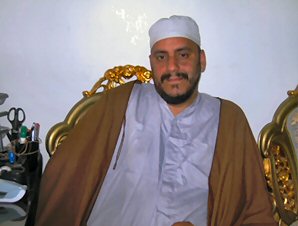 “In an effort to gauge whether we, the students, are ready to take classes in the upcoming year in Arabic, the Institute invited second year teachers to take a class to measure our understanding. Sheikh Yahya who will be teaching Khitaba in the following year, gave a lecture on the importance of seeking knowledge. He quoted a Hadith from the Imams (AS): ‘A seeker of knowledge walks on the path towards Paradise’. He described how the Angels get excited when a seeker of knowledge goes out looking for it, and how that seeker walks on the wings of Angels. Sheikh Yahya described three characteristics needed
for seekers of knowledge: Sincerity, Patience and to Apply what they have learned. He beautifully narrated a story about Ayatullah Ansary and his journey towards becoming a Grand Ayatullah, and how he applied all three of these characteristics on his journey towards seeking knowledge. I found Sheikh Yahya's delivery of his lecture to be beautifully presented, with lots of information that was conveyed in a manner easy to remember. I look forward to learning from him in the upcoming year”.
Feedback from Sheikh Yahya:-
“I observed students in the areas of spoken, understanding and listening Arabic through the way in which they expressed themselves. I found that the students are ready in all three areas for the second year”.
Comments from Sabiha Karim (Student) following Sheikh Samir Ubaid’s (Evaluator) lecture on ‘Fiqh’:-
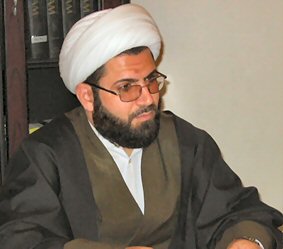 “Sheikh Samir, our Fiqh teacher in the upcoming year, came to our Institute to measure our readiness for the classes next year. He was pleasantly surprised, as we knew most of the Fiqh terminology that we shall be using next year, and felt that we are ready to begin taking classes in Arabic. Sheikh Samir described how all the Fiqh related rules could be broken down into two areas; Ibadat (worship) and Mu-Amilat (work). Ibadat, are all the actions that we do with the intention of getting closer to Allah (SWT), like praying and fasting, whilst Mu-Amilat are all the actions that we perform without the intention of getting closer to Allah (SWT), like business transactions and contracts. He wonderfully described these two areas and how everything we do in our lives falls within them. I found Sheikh Samir to be relaxed with a great sense of humour, and am very excited for the upcoming year when we can benefit from his vast knowledge on this very important subject”.
Feedback from Sheikh Samir:-
“I was pleasantly surprised at the level of Arabic the students currently possess, especially as this is only after a few months into their studies. It was only four months ago that I came to the Institute and briefly assessed the students. Today, these students are capable of expressing and understanding Arabic at a firm level within the vocabulary of Fiqh”.
Comments from Staff
Sheikh Kassim Assady, Arabic Module Co-ordinator at IIPS, upon receipt of the grades from the external auditors, had the following to say:-
“I was very happy that all external observers who came to judge the level of my students found them ready to move into the 2nd year, where all classes shall be conducted in Arabic. Even though they are ready for this, I hope to achieve further goals within the next six weeks. It is then that I would be able to judge the competencies of the students against the course aims, and assess if they are fully ready for the next year”.
Sheikh Sami Bo Khamseen, the Educational Director of IIPS concluded the proceedings by commenting:-
“While the auditors were carrying out their evaluations, I was confident that they believed that my students were ready for the second year. I was very happy with the performance of the students during these sessions, as they were all able to confidently communicate with the evaluators. I am looking forward in assisting my students for the rest of the year in areas that are needed for development.”
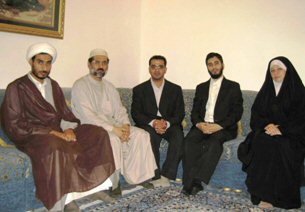
Al Hajj Hussein Ravji, Manager at IIPS analysed the evaluations and the first academic year:-
“As we are nearing the final portion of the academic year, I can express confidently that the time spent here has been very carefully utilised. It has been both, challenging and rewarding for the students as well as the staff. After reviewing the independent external evaluators’ feedback, which took place six weeks prior to the end of the academic year, I am now in a position to summarise my views and hopes. The assessors were asked to outline and quantify student development from a non-biased perspective. Alhamdulilah, all students have consistently proved themselves throughout the rigorous academic year and have worked to an admirably high standard, given the intensity of their daily schedule. This tremendous hard work was substantiated from the feedback we received from the external Auditors. It therefore, gives me great pleasure to announce, the now proven success of the first year at the IIPS. This has all been possible through team effort by all at the IIPS, where unique approaches were implemented in teaching Arabic. All lecturing staff have dedicated themselves to IIPS and have made this year the successful platform that it is for the future years. They gave their full and undivided attention to development and progress of our students. Words fail me to express my thanks and gratitude to the MTP team, both locally and globally for their selfless dedication in obtaining the success thus far. I hope and pray for the continued success of this single, most important project for our community worldwide, initiated by The World Federation. All of us at the Institute are looking forward to the following academic year, and are wholeheartedly committing ourselves to maintaining the same high standards that we have achieved so far”.
Click here to read more articles on IIPS.
For further information, email iips@world-federation.org