Updated 27 September 2011
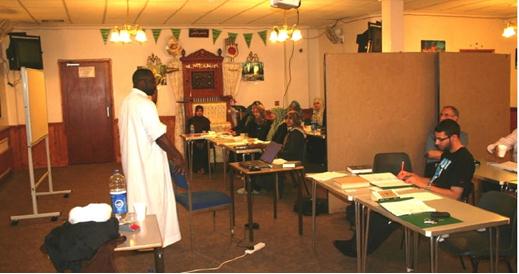
Sunday the 10th of September 2011 marked the beginning of a new era of teachers training in our Madaris as part of the WF Islamic Education Madrasah initiative.
The training was held at Peterborough Hussieni Madrasah and was conducted by Shaykh Mohammed Zakaria. The seminar focused on enhancing professional teaching practice. This approach centred on an ethical-spiritual orientated learning experience.
Principle 1: Islamic pedagogy
Shaykh Zakaria began by defining the parameters of Islamic pedagogy (Ta’leem ul Adamiyyah) and how the Islamic approach differs from secularist systems of education. He explained how Islamic pedagogy models itself on the first instance of teaching and learning mentioned in the Qur’an, where Allah (swt) adopts the role of a teacher / educator. Allah (swt) not only teaches Nabi Adam (as) he also gives him exactly what he needs to successfully assume the role of Khalifatullah (Allah’s representative). The divine teaching of Nabi Adam (as) is replete with:
A. respect
B. honour
C. love
D. compassion
This method represents an expression of complete and all-pervading divine love.
Shaykh Zakaria explained how Madrasah teachers should try and emulate this love within the Madrasah teaching and learning cycle, as they are in fact trying to take on a role which Allah (swt) has dignified and given sacredness to, as it is He who is the First Teacher.
Principle 2: Reflective Practitioner
The principle of the ‘Reflective Practitioner’ was then introduced to the attendees. Teachers can sometimes be concerned only with how knowledge is presented via the resources, or how lesson plans and schemes of work should be crafted.
The Islamic approach to ‘Reflective practice’ however, also asks teachers to reflect on the reasons that have brought them to the Madrasah’s teaching and learning environment. It asks them to engage their souls in a critical manner, using what they have learned from their individual practice to spiritually-ethically enrich the interaction which takes place between them and their students.
Principle 3: Developing Faculty Cohesion
The topic then changed with attendees discussing the importance of ‘Developing faculty cohesion.’ Shaykh Zakaria developed a line of thought which highlighted the need for a faculty mentality to arise amongst teachers who selflessly donate a considerable amount of their time to the Madrasah. Shaykh mentioned that there must be open and constructive critical discussion amongst faculty members, and that the strength of any Madrasah lies with faculty members buying into a range of shared aims and objectives and have a unified and coherent stance; this can only be brought about via meaningful avenues of dialogue being opened between faculty members.
Principle 4: Individual Teacher Learning
Shaykh Zakaria then addressed the issue of individual teacher learning, using the Qur’anic verse where Prophet Muhammad (saw) asks; ‘O my Lord! Increase me in knowledge.’ (20: 114). He explained that by taking the blessed Prophet Mohammad (saw) as an example, the continued pursuit of knowledge and understanding must be directed by a sincere struggle for spiritual purification and reform.
Principle 5: Making Learning Relevant
The issue of relating the teaching and learning which takes place within the modern Madrasah to the lives of the students within wider British society was discussed. Shaykh explained the importance of using unique personal biographies and experiences of both students and teachers as valuable resources within the teaching and learning cycle. It is imperative that the modern Madrasah teacher is aware of the secularism and the challenge of atheism that is current within contemporary British education, and that the vast majority of Madrasah students have to tackle and navigate. Using Islamic pedagogy, Madrasah teaching and the interaction it leads to is in fact a healing; it heals the student of the knocks and scrapes they have encountered throughout the week spent within the secular, humanist, atheistic school environment. The Madrasah teacher that uses Islamic pedagogy therefore applies a soothing ointment to the wounds and bruising that has been inflicted on the student. The professional teacher within the modern Madrasah works to heal the heart and spirit of students by representing stability and clarity of faith and behaviour.
Principle 6: Professional Boundaries and Responsibilities
Finally drawing the seminar to a close, the idea of ‘Professional boundaries and responsibilities within the Madrasah’ was discussed. The attendees took the opportunity to critically assess the role they adopt and how that role naturally comes with a number of responsibilities. These responsibilities are essentially there to safeguard both teachers and students, allowing for a secure and safe environment of teaching and learning to be created where all are valued.
If you are a Madrasah and are interested in exploring Teachers Training through Islamic Education please email us on islamiceducation@world-federation.org
To contribute to the Madrasah Initiative click here