|
The World Federation is an NGO in Special Consultative Status with the Economic and Social Council (ECOSOC) of the United Nations
Vision Statement
The World Federation
exists to achieve the
pleasure of Allah SWT by
developing spiritual and
vibrant communities
serving humanity
Mission Statement
The World Federation
enables its member institutions
to promote the
values and practices of the
Islamic Shia Ithna Asheri
Faith for the spiritual and
material well being of
humanity at large
|
Islamic Institute for Postgraduate Studies - ‘An ideal project for future religious needs of the community’
This is what Maulana Zaffer Abbas summarised the Muballigheen Training Programme as, following his recent visit to the campus in Damascus, Syria. Maulana Zaffar Abbas, President of the Majlis Ulema-e-Shia and a prominent Alim currently residing in London, UK, received first hand experience of the Course, looking at the teaching methods and conversing with the students and the lecturers. Following his visit, Maulana Zaffar Abbas was interviewed, covering a variety of questions and possible concerns ranging from the suitability of the venue, the course structure, and the lecturers.
|
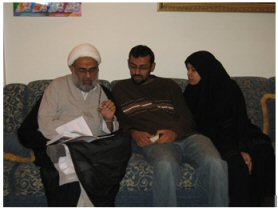
|
| Maulana Zafar Abbas with IIPS Students Jaffer and Sabiha |
|
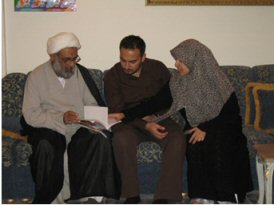
|
|
Maulana Zafar Abbas with IIPS students Hussanain and Samayra |
Maulana Zaffar Abbas said, “In my view, community leaders have made an ideal project for future religious needs of the community. The communities living in Western countries especially require well-prepared scholars who could guide the community according to the needs of the time, via the Holy Quran and Ahadith. I believe that this is the first such project in all Shia communities, which has been started by the Khoja community, and I hope it will benefit not only the Khoja community, it will inshaAllah help all the Shia communities in the world.”
|
|
|
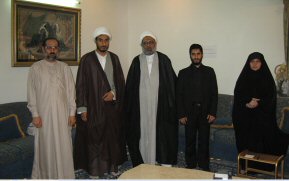
Maulana Zafar Abbas with IIPS teaching staff |
What are your views of the IIPS venue being Syria? What did you think of the new campus site, the new buildings/structure?
The venue of the Institute is according to the needs. A good standard living accommodation and place for classes has been hired which provides all the needs of living as well as studying. Syria as an Arab country will help students learn the Arabic language faster. In addition the availability of several Hawzas there allows for a greater choice of lecturers and teachers. The new campus is ideal, suitable for educational purposes and a short distance from Zainabiyya.
What do you think of the course structure?
I think the structure of the course involves a combination of traditional Hawza methods and modern approaches. Mastering the Arabic language will be beneficial to the students in understanding the Holy Quran and Ahadith directly. Through Fiqh and Usool-ul-Fiqh, they will gain the ability to understand the background of Fatwas and the method of giving Fatwas, and through Mantiq they will understand the logic of all knowledge, including the sciences of this time. Through modern religious approaches they will be able to face the challenges of the time and they will be able to set new approaches for the preaching of Quranic and Hadith studies.
How does this course compare with other similar ones in Qum and Najaf?
Najaf and Qum have their own nature of religious education and knowledge, and they are carrying on this practice. Students take their own time without any limitation and they get the benefits according to their personal abilities and qualities. This project has a specific objective, and therefore aims to cater for the objective.
How are the teaching methods and the lecturers?
Lecturers are sincere and trying their best to fulfil their responsibilities. Because they are experiencing teaching the graduates of Western universities for the first time, there is a need of developing the method and efficiency. Administration is fully aware of this and is trying to give full support and aid to the teachers. My visit was a part of this attempt.
In your conversations with new students, what did they say?
Students are fully satisfied with the accommodation and campus, and are fully committed to this cause. I discussed with them about various aspects of their studies, including spiritual values and daily life as a religious student, which they were keen to learn about. I gave them some study tips based on my experience, which will hopefully be useful to them.
What would you recommend to anyone who is considering going there?
Individuals thinking to join them must be sincere, committed and have the enthusiasm to serve the communities fully with their hearts.
What are your views on this program being good for our community?
As much as the community is interested in building new centres day by day according to the needs of the time, I hope full efforts are given into this project to fill the needs for the future generations, and to provide the centres with well-capable scholars and Muballigheen who can fulfil their responsibilities of Mimbar and Mihrab.
Briefly, can I please have your introduction and background?
I began my religious studies in Pakistan in 1959 and completed a certain level in 1969. From 1969 to 1974, I worked as a teacher in a Hawza Ilmiyya of Pakistan. From 1974 to 1979, I was working as Chief Missionary of Bilal Muslim Mission Kenya, where my main role involved teaching Shia aqaid and fiqh to the Muallims of Sunni Hawzas and Madaris. During this time I was also serving Mombasa Jamaat as Resident Aalim. From 1979 to 1981, I lived in Karachi working with Bilal Trust, where I was looking after madaris in several mosques. Within this period, with the support of the trustees of Bilal Trust, we established a Hawza Ilmiyya for the Sindhi community at a place called Wah Ghhreji. In 1981, I came to Birmingham as the first Resident Aalim of Birmingham Jamaat. In 1983, the World Federation established the Hawza Ilmiyya in the name of Madressah-tus-Syed al-Khoei and I took the responsibility of Principal of the Madrasah. At first classes began in Birmingham and then in 1985 they relocated to Stanmore, London. I worked for the Hawza Ilmiyyah until 2002 when it was situated at Dar-al-Tableegh. Meanwhile, I served the Shia Ulema and the non-Khoja Shia communities in Europe through the platform of Majlis Ulema-e-Shia, Europe (an organisation of Shia Ulema from India and Pakistan serving communities) as its President. In 2002, when I was in Pakistan, I had a severe heart attack after which I could not continue these services. For about 4 years, I was in bed because of my poor health. By the grace of Allah (SWT), during the past two years my health has been improving and I partly resumed religious services, doing what I can. The responsibility of Majlis Ulema-e-Shia has again been put upon my shoulders as I am the current President.
To find out more about the Muballigheen Training Programme, click here or email islamiceducation@world-federation.org
|
What's New :: Islamic Education
|